

Australian Market
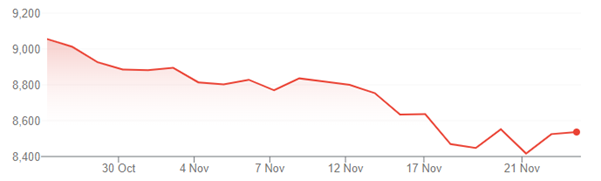
At the time of writing (25 November), the domestic market is down nearly 6%, reflecting another period of heightened volatility and mixed news-flow.
Inflation is now expected to remain above the RBA’s 2-3% target band into mid-2026, while unemployment has edged lower. Together, these factors have reduced the likelihood of a near-term interest rate cut. Higher-for-longer rates influence equity markets by improving the relative return on cash and keeping debt-servicing costs elevated for businesses. Our approach remains unchanged: we do not attempt to forecast interest rates and instead focus on investing in companies with strong balance sheets and durable earnings.
S&P/ASX 200 (1-Month)
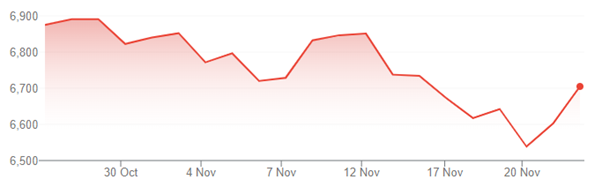
The US market declined around 2.5% in November. The prolonged US government shutdown created a “data blackout,” making it difficult to assess real-time economic conditions and complicating Federal Reserve policy formation. Markets weakened during the blackout but rallied once the shutdown ended.
S&P 500 (1-Month)
Company Spotlight: NVIDIA
NVIDIA delivered a strong quarterly earnings result in November. The company now represents roughly 7% of the US market index (with a market cap of approximately US$4.4 trillion), so its update was closely watched.
The results-and guidance for 2026-were very positive. Still, valuations among mega-cap technology names, particularly those investing heavily in Artificial Intelligence, continue to spark debate. Concerns about an AI-driven bubble are widespread, though historically such commentary has rarely been a reliable indicator of an actual bubble forming.
Investment Perspective
Attempting to time the market in anticipation of specific events-such as a “bubble burst”-carries significant opportunity cost. Markets naturally move through phases of volatility, including both strong advances and meaningful drawdowns, but these cycles are unpredictable.
Over the long term, markets tend to rise. We continue to advocate for long-term investing, with portfolios adjusted according to each investor’s risk profile, which can evolve over time-most notably with age.
Alex Leyland