

The Australian market has finished the month relatively flat, as companies reported FY26 earnings numbers.
Australian companies have generally delivered a resilient reporting season, but the quality of earnings is mixed. Companies are managing costs well, but broad-based revenue and earnings growth remain relatively modest.
Overall, around 45% of companies have beaten expectations versus 25% missing, modestly better than long-run averages. However, FY27 earnings forecasts have subsequently been reduced by around 2%.
Our largest company, BHP, delivered a particularly strong FY26, with underlying EBITDA of approximately US$33bn. Interestingly, copper has now become the company’s largest earnings contributor, overtaking iron ore. BHP believes it can increase copper production by around 40% by FY35. This is important because copper is required in a number of future facing industries including data centres and the energy transmission.
CSL was another notable result, which was positively received following a period of underperformance. Earnings stabalised, vaccination rates in the US have started ticking up again, cost-out initiatives are progressing, and a share buy-back is in place. Although several assets were written down in value, this will help reset the earnings base and remove some legacy issues from the balance sheet.
The banking sector accounts for about 35% of the ASX 200 index, and although results were generally resilient, guidance was cautious mainly due to interest rate rises and government policy settings impacting demand for residential investment loans.
Internationally, USA based AI companies remain the dominant drivers of performance. However, many global markets (x-US) have performed well as funds are increasingly flowing to more traditional assets. If performance continues to broaden beyond US mega-cap technology, this could be a tailwind for Australian equities, particularly industrials, resources and selected healthcare names.
Rising US Long-Bond Rates – watch this space
On global macro, aside from the usual geopolitical and inflation issues, the long-dated US bond rate has started to rise.
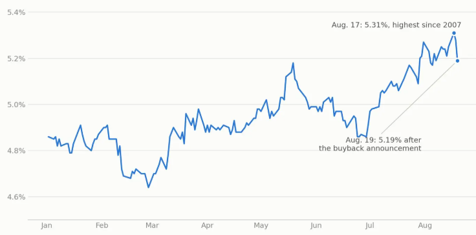
This is seemingly not only in response to inflation, but the view that the US government $40 trillion debt is becoming increasingly unsustainable. The US Treasury Department has responded by increasing the buy-back of its own bonds saying it is to generate liquidity; however, this appears to be more about tempering the rise in interest rate – limiting government debt servicing costs and the impact on financial markets.
Note that this is separate to central bank quantitative easing, as the Treasury Department is a government agency.
Alex Leyland